


5/5 Simon of the Desert (1965, available through the Criterion Collection)


I'd like to start off by saying that Belle de Jour is a very good picture and everyone with an interest in Bunuel should see it and form their own opinion about it. It's a classic of French cinema, a milestone for Surrealist cinema, features some very famous French actors (Catherine Deneuve is famous enough to even get name-dropped in something as mainstream as TV's Gray's Anatomy and Michel Piccoli, who starred in Godard's Contempt, also has a large role--they're both in the picture below.) But in terms of Bunuel's other pictures, in my opinion, it is only a very good picture among a host of total masterpieces.

I have been trying to pinpoint why Belle de Jour has never been a favorite of mine. The film deals with the life of a wealthy young woman who is somewhat frigid with her handsome doctor husband, but has wild masochistic sexual fantasies. She decides to start working at a whorehouse on the first anniversary of their marriage, where she hopes to find her much-wanted sexual degradation. It is definitely an intriguing picture and full of more feminist sentiment than one might expect.

Belle de Jour was Bunuel's first collaboration with Jean-Claude Carriere, who co-scripted almost all of Bunuel's films from this point on (Bunuel always enlisted the help of other writers and he had a particularly good relationship with Carriere, who he maintained a close friendship with until his death.) It is also the first in the string of late art house masterpieces and near-masterpieces that Bunuel made in France in his third and final period of filmmaking. Of the four of these I've seen, I would rank them with The Discreet Charm of the Bourgeoisie and That Obscure Object of Desire vying for the first slot, The Phantom of Liberty coming in a close second and Belle de Jour easily in third.

In any case, I think Belle De Jour has a great script and I think it is excellent in it's characterization of Severine (a.k.a. Belle de Jour, played by Catherine Deneuve) and especially so in it's characterization of her jealous lumpen proletarian boyfriend, Marcel (played to perfection by Pierre Clementi), who ends up sending her husband into a wheelchair-bound coma and gets shot down in the street in a scene quite reminiscent of the final moments of Godard's Breathless.


My main problem, actually, is the cinematography. This is strange because the cinematographer Sascha Vierny lensed some of the most visually stunning movies I've ever seen, including having a long working relationship with both Alain Resnais--for whom he shot notoriously beautiful films like Night and Fog and Last Year at Marienbad--and, much later, the little-known, but immensely talented Raul Ruiz, working on Hypothesis of the Stolen Painting and The Three Crowns of the Sailor, among others.

The key may lie again in Bunuel's autobiography, where Bunuel, though he doesn't specifically talk about Vierny, makes fun of people who speak of him as a stylist, because "aesthetic concerns never occupied much of my time." Bunuel is character-driven, plot-driven, idea-driven, and image-driven, but he's right--style is rarely a factor. Although Resnais and Ruiz are in many ways Bunuel's worshiping surrealist disciples, they are definitely very style-oriented filmmakers: Resnais is often accused of ripping off style-as-content avant-garde filmmakers from the U.S. in Marienbad and Ruiz is as much a disciple of Orson Welles' showy, beautiful chiascoro-lit compositions as he is, in every other matter, following in Bunuel's footsteps.

Vierny doesn't seem to have much to do here--there are a lot of complex tracking shots, coming well before the invention of steadicam, which must have been challenging to execute, but seem a little too self-consciously mannered and showy for a great Bunuel film. It's as if Bunuel didn't know what to do with such an arty cinematographer and just left him to rove around the set with a crane. The style in your typical Bunuel film--if you can speak of cinematographic style in his films at all--is very upfront, matter-of-fact and even in-your-face, which is rarely the case here.

The other great cinematographer that Bunuel worked with was Gabriel Figueroa, on his last Mexican film, Simon of the Desert. Figueroa seemed to really understand Bunuel's style and perhaps too, with Simon stuck on top of the pillar for most of the film, there was necessarily less roving around--many of the tracking shots feel extremely economical and there are many gorgeous stationary camera compositions.

Simon of the Desert follows, as I mentioned in another review, the life of a religious ascetic who lives and prays, unwashed and unshaven, on top of a tall, but not very spacious pillar in the middle of the desert.The whole film is a reworking, as I understand it, of Christ's Temptation, and based on the lives of a few saints who actually did habitate the tops of pillars. Simon is filled with some of the most hilarious bits of (sac)religiously-themed humor to be found anywhere, though there are basically only two actors at work for most of the hour long film, Silvia Pinal as the Devil-as-woman-in-various-costumes(and who also played the lead role as the chaste do-gooder in Viridiana) and Claudio Brook as the long-suffering Simon.
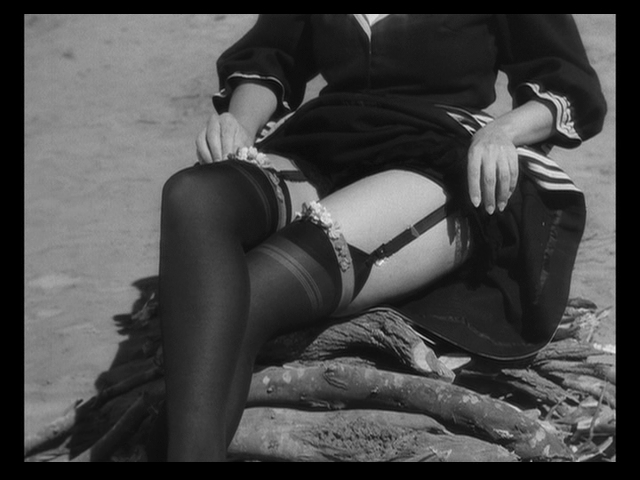
Simon of the Desert is definitely one of the masterpieces and I won't even go into the details of the plot any further, which everyone should discover for themselves, and just say that it is one of the most stunning works, visually and otherwise, in a long career filled with various moments of shock and awe.* It is interesting to ponder that many people have referred to Bunuel as one of the most religious of filmmakers, even though half his life's work is explicitly making fun of the Church. The Milky Way, apparently, is so full of clerical in-jokes that some people accused Bunuel of having become a convert. He followed it up with a vicious satire of a the priesthood in Discreet Charm though, and I doubt anyone questioned his religious opinions again.

* (Pauline Kael's review of this film is especially good and a little more critical. A selection of her reviews, which were my movie watching bible for half a year or more can be found at your local library or on my bookshelf, if you're so inclined.)


