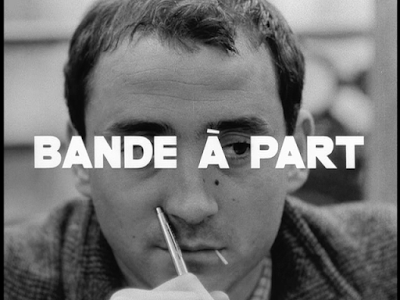
5/5 Bande A Parte (1964)
I'm taking a little furlough from Bunuel to write about that other favorite of mine: Jean-Luc "Cinema" Godard. I've been recently working my way again through some of his sixties movies concurrently with my Bunuel watchings and rewatchings. Recently, I've seen Alphaville again, Pierrot Le Fou, Masculin-Feminin, Breathless again, and Contempt. But really what I want to write about is Band of Outsiders, which I've watched twice in the last two months after seeing it for the first time about a year ago.

There are some Godard movies that I've instantly liked--Breathless, Pierrot Le Fou, Week End, and La Chinoise (the name of my blog is an attempt at punning with this name, which is itself a pun on the French words for "Chinese" and "foolishness")--and others that have taken awhile to grow on me, especially Alphaville and Band of Outsiders. Band of Outsiders, compared to Godard's works with weightier (sometimes ponderously weightier) subject matter and style, feels like a fluffy, puff-ball of a movie. At least that's how it felt the first time around. And I can't help but feel sometimes that Godard's more political movies, which he made after Pierrot Le Fou (65), up through Week End (67), after which he, by all accounts, went all the way to become a batshit-crazy Maoist "guerrilla" filmmaker, have been the less popular of his productive 60s period because people don't like the questions Godard is exploring and find his politics undesirable (I, on the other hand, have a healthy appreciation of 60s social revolution and tend to really dig these movies.) Band of Outsiders is solidly in the earlier half of Godard's sixties' filmography and thus is more "romantic," as is often the term for the first phase in his work.

What I've realized on repeat watchings of Band of Outsiders, though, is that it really isn't a fluff picture. Sure, this may be Godard at his most playful, but he's still playing with some fairly serious stuff--kids so obsessed with old Jimmy Cagney movies that they decide to commit a real crime and who are borderline unsympathetic characters because of their abject cruelty and stupidity.
I got my girlfriend to watch Band of Outsiders with me last night, and as always, since she's so smart and literate, she inevitably had ideas about the film that were surprisingly perceptive, although she only sort of liked it (I busted her French New Wave cherry awhile back with Truffaut's The Bride Wore Black and The Wild Child, both of which she loved, but this was her first and only (?) Godard movie.)
Some intelligent comments from Anna:
Before watching it, she said, "[Band of Outsiders] sounds interesting--kind of like Crime and Punishment."
And afterwards, her main criticisms: "What did they even do for that whole first half of the film? They didn't do anything!" and, "Arthur was a total dick and I wanted to like Franz, but he was a dick sometimes too. I felt bad, because the guys kept making fun of her, but Odile [Anna Karina's character] really was stupid."

Somehow, it wasn't really until this third viewing with Anna that I really fully (?) understood Band of Outsiders. The first time I perceived it as enjoyable fluff. The second time it was starting to dawn on me that this was really a movie about boredom and media-saturation. The third time, I finally saw that although this film has some of the most poetic/romantic sequences in any film I've ever seen--the English teacher reciting Romeo and Juliet as Arthur passes Odile notes in class, the cafe scene with the "minute of silence" and the dance, Odile singing on the train as Godard segues into montage (my favorite) and the scene of running through the Louvre and beating the record of "Jimmy Johnson of San Francisco"--"romantic" is really an incorrect term for the film, because Godard is obsessed with the same things here that he always is, namely how culture, technology and especially pop-culture (be it 60s pop-Marxism, pop music or old American crime movies) mediates our perception of reality and how we deal with the absolute boredom--I can't think of another way to put it--of being modern and having more time on our hands than maybe ever before in the history of the human race. Shit! Godard is a film artist if ever there was one--these are themes suited to a great novelist or an epic poet, but also, curiously enough, there may not be a better way to express this state of being than by making a film in the characteristically off-the-cuff turned-on style that Godard adopts here. Tarantino may admire Godard, I admit, but he has nothing on him either--although he borrows some characteristically Godard-like themes of media saturation, Tarantino obviously plans out his films as much as Hitchcock ever did, using closely honed scripts and a lot of storyboarding, though his latest film Inglorious Basterds evidences a little more (and enjoyable) improvisation.

I recently remarked to a friend that I felt like Godard had no real descendants besides the music video (Odile's singing scene here seems like a precursor) and reality television (i.e. interviews and confessions straight to a camera in an essentially unplanned way.) I guess I can see throughout film since the late 60s, though, some of his jump cuts and, especially since the 90s, some of his jittery post-modernism, carried out in America by Tarantino, the Coen brothers, etc. But nobody, except maybe Altman, who for some reason I can't really get into, has been as wholly off-the-cuff and improvisational as Godard--this, to me, is the most important possibility that he revealed in cinema. Despite their obvious stylistic differences, maybe it's really Kiarostami who most makes films like Godard used to--his films feel similarly unscripted and similarly post-modern (especially in Close-Up.) As Jonathan Rosenbaum has remarked more than once, Kiarostami's rural explorations of Iran in the 90s and 2000s, which are invariably poetic and strangely modern, having relevance far beyond the Islamic Republic, may have an analogous relation to Godard's 60s movies, which often feel like chunks of 60s urban modernity, not merely taking this as their subject.

In any case, Band of Outsiders is a great film. The kids seem to commit the crime out of boredom. They're horrible and hilariously witty at the same time. Godard's inventiveness here is intimidating--something interesting is happening in every sequence, and as with me, you may not pick everything up on the first viewing. As always, his sense of shot composition is awe-inspiring--you could watch this film, as I talked about in my article about art films and Lynch's Inland Empire, just for the shot composition alone and have a hell-of-an-enjoyable time. Watch it, rewatch it, dig his experimental use of sound, dig the love triangle, dig the comment on modernity, dig the silly gangster plot, just watch it!


